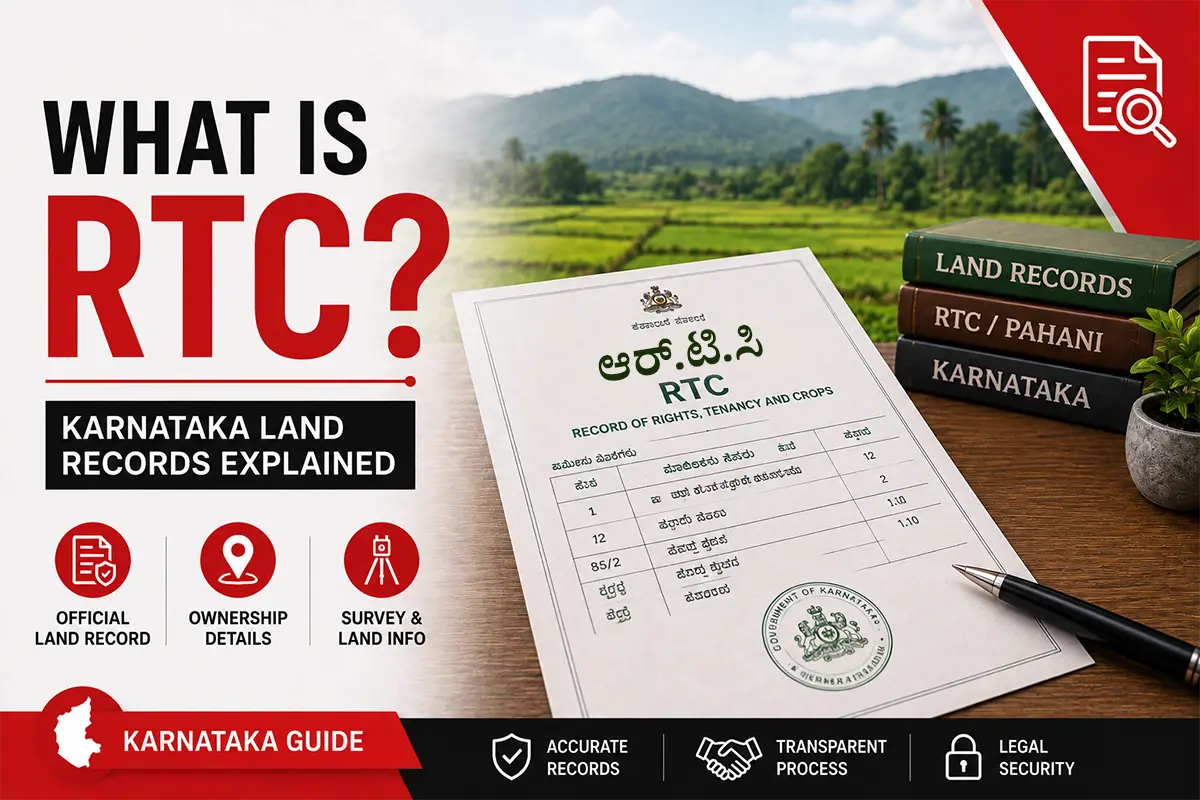
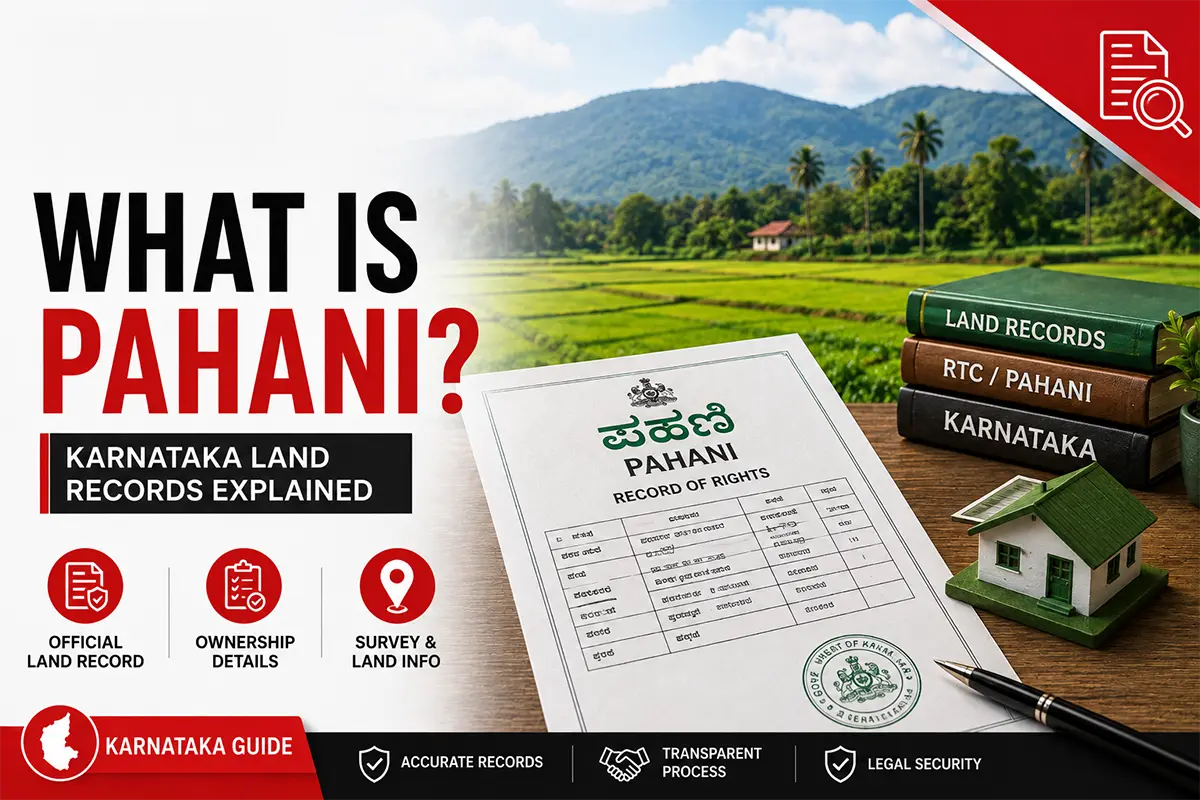
If you are buying land in Karnataka, you will often come across the term Pahani.
Pahani is a commonly used term for a land record in Karnataka. It is closely associated with RTC, which stands for Record of Rights, Tenancy and Crops.
For a land buyer, understanding Pahani can help you read important information about a parcel of land and compare it with the seller's other property documents.
However, Pahani should not be treated as a complete title document or as a substitute for legal due diligence.
Quick Answer: What is Pahani?
Pahani is a land record used in Karnataka that contains information relating to the rights, tenancy and crops associated with a parcel of land.
It is commonly referred to along with RTC as RTC/Pahani.
Depending on the record, you may find information such as:
Owner or landholder details
Survey Number
Hissa or subdivision details, where applicable
Land extent
Tenancy-related information
Crop or cultivation details
Other revenue-record information
For property buyers, the most useful purpose of Pahani is to compare its information with the Sale Deed, mutation records, survey details and other relevant documents.
What does Pahani mean?
Pahani is a commonly used term for a land record in Karnataka.
You may see or hear:
Pahani
RTC
RTC/Pahani
ಪಹಣಿ
The terminology can sometimes cause confusion because people may use RTC and Pahani interchangeably in everyday property discussions.
For a buyer, the important thing is to obtain and understand the current official land record applicable to the property.
Is Pahani the same as RTC?
RTC and Pahani are commonly used together when referring to Karnataka land records.
RTC stands for:
Record of Rights, Tenancy and Crops
In practical property discussions, RTC/Pahani is a common way of referring to this land record.
Rather than focusing only on the terminology, buyers should focus on the actual record and the information it contains.
If you are checking a property before purchase, verify the current official record through the appropriate Karnataka land-record service.
What information does Pahani contain?
Pahani can contain several types of information about a parcel of land.
1. Owner or landholder details
The record can contain information about the person or persons recorded in relation to the land.
This is one of the first details a buyer should compare with the seller's ownership documents.
2. Survey Number
The Survey Number identifies the land parcel within the relevant land records.
Always compare it with the Survey Number in the Sale Deed and other relevant documents.
3. Hissa or subdivision
Where applicable, the land may have a Hissa or subdivision reference.
This can be important when a larger survey parcel has been divided into separate portions.
4. Extent of land
The record can contain the recorded extent of the land.
Compare this with the extent mentioned in the Sale Deed and other relevant property records.
5. Tenancy information
Where applicable, tenancy-related information may be recorded.
This can be relevant when examining agricultural land and its recorded history.
6. Crop or cultivation information
The "Crops" component of the record relates to cultivation or crop information recorded for the land.
This can help provide context about agricultural use recorded against the parcel.
Why is Pahani important for property buyers?
Suppose you are considering purchasing agricultural land.
The seller gives you a Sale Deed showing a particular owner, Survey Number and extent.
You can then examine the relevant Pahani/RTC and compare the information.
For example:
Detail | Sale Deed | Pahani / RTC |
|---|---|---|
Owner name | Check | Check |
Survey Number | Check | Check |
Hissa | Where applicable | Where applicable |
Extent | Check | Check |
Land details | Check | Check |
The goal is to establish whether the documents appear to describe the same property and ownership situation.
If something does not match, investigate it before proceeding.
Is Pahani proof of ownership?
This is an important distinction.
Pahani is an important revenue record, but it should not be treated as a complete substitute for title verification.
A buyer should not assume that the property is legally safe to purchase simply because the seller's name appears in Pahani.
You should also examine relevant:
Sale Deed
Previous ownership documents
Mutation records
Encumbrance Certificate
Survey records
Land-use or conversion records, where applicable
Other documents relevant to the property's history
For complicated ownership histories, professional title verification may be necessary.
What is Bhoomi?
Bhoomi is Karnataka's land-record management system.
It was developed to computerise land records and provide land-related records and services.
Karnataka government material identifies Bhoomi as a system associated with land records, including RTC and mutation-related information.
For a buyer, Bhoomi is therefore an important official source when checking land records.
The exact services and online procedures can change, so use the current official Karnataka land-record service when accessing records.
How is Pahani related to Bhoomi?
A simple way to understand the relationship is:
Bhoomi → Karnataka land-record system → RTC/Pahani and related records
Bhoomi is the broader land-record system, while RTC/Pahani is a specific type of land record associated with it.
When checking a property, make sure you are looking at the correct village, Survey Number and Hissa details.
How can you check Pahani in Karnataka?
Pahani/RTC records can be accessed through Karnataka's official land-record services associated with Bhoomi.
Depending on the service, you may need details such as:
District
Taluk
Hobli
Village
Survey Number
Hissa Number, where applicable
The exact information required may vary depending on the record and service.
Before relying on an online record, make sure you have selected the correct property identifiers.
What should you check in Pahani before buying land?
If you are considering buying land, focus on the information that helps you identify the property and compare it with the seller's other documents.
Check the owner or landholder details
Compare the name in Pahani with:
Seller's identity
Sale Deed
Previous ownership documents
Mutation records
A mismatch should be investigated.
Check the Survey Number
Make sure the Survey Number corresponds with the property being offered to you.
Check the Hissa
If the property is part of a larger survey parcel, check the applicable Hissa or subdivision details.
Check the extent
Compare the recorded extent with the Sale Deed and other relevant documents.
Check tenancy and cultivation information
Review the relevant entries rather than assuming that every field has the same significance for every property.
If an entry is unclear, obtain appropriate clarification before proceeding.
What if Pahani and Sale Deed do not match?
Do not ignore the difference.
A mismatch may have an explanation, such as:
Subdivision
Mutation or other record changes
Correction
Different property references
An error
Another change in the property's records
The reason should be established using the relevant supporting records.
If the owner name is different
Check:
Sale Deed
Previous ownership documents
Mutation records
Current revenue records
Any relevant transfer or inheritance documents
If the Survey Number is different
Check:
Hissa or subdivision details
Survey records
Property description
Extent
Boundaries
Do not rely solely on a verbal explanation from the seller.
What is mutation and how is it related to Pahani?
Mutation refers to changes recorded in the relevant land revenue records following a transaction or another event affecting recorded land rights.
Mutation can therefore affect the information shown in current revenue records.
A simplified relationship is:
Property transaction or relevant change → Mutation process → Updated revenue record
When buying property, compare the mutation information with the underlying ownership documents and the current Pahani/RTC.
Is Pahani enough to buy land?
No.
Pahani is one part of the property due-diligence process.
Depending on the property, you may also need to examine:
Sale Deed
Previous ownership documents
Mutation records
Encumbrance Certificate
Survey records
Land-use or conversion documents, where applicable
Property tax or Khata records, where applicable
Layout and approval records, where applicable
Seller identity and authority documents
The exact documents depend on the property type and its history.
Pahani and Encumbrance Certificate: What is the difference?
Pahani and an Encumbrance Certificate provide different types of information.
Pahani / RTC
Provides revenue-record information associated with the land.
Encumbrance Certificate
Provides information about registered transactions and encumbrances recorded for the period covered by the search.
This means they should be viewed as complementary records.
A buyer should not rely on either one alone when evaluating a property purchase.
Can Pahani show whether land has a loan?
Do not assume that Pahani alone will reveal every financial or legal issue affecting a property.
This is one reason buyers should also examine the EC and relevant title and registration documents.
If a mortgage or other transaction appears in the available records, ask for supporting documentation showing how the matter was resolved, where applicable.
Can Pahani show whether land is agricultural?
Pahani contains land and cultivation-related information that can help a buyer understand the revenue record associated with the parcel.
However, do not make a major land-use or construction decision based only on one entry in the record.
If you plan to construct a house or use the land for another purpose, check the applicable current land-use and conversion requirements separately.
Pahani for agricultural land
Pahani is particularly relevant when examining agricultural land because it can contain information associated with cultivation, land rights and other revenue details.
Before buying agricultural land, compare the Pahani/RTC with:
Sale Deed
Previous ownership documents
Mutation records
EC
Survey records
Land-use or conversion records, where applicable
Agricultural land transactions can involve additional legal considerations depending on the property and the intended use.
Do not rely on outdated general statements about agricultural land ownership or use.
What is the difference between Pahani and Mutation?
Pahani/RTC is a land record containing information about the parcel.
Mutation is the process through which relevant changes are recorded in the land revenue records.
In simple terms:
Pahani/RTC = Land record
Mutation = Record of a relevant change
They are related, but they are not the same thing.
Can Pahani show property boundaries?
Pahani can contain important land identifiers and recorded details, but it should not automatically be treated as a complete physical survey of the property.
If you are uncertain about:
Exact boundaries
Physical extent
Encroachment
Survey subdivision
Location on the ground
additional survey or technical verification may be necessary.
Common mistakes buyers make when checking Pahani
Mistake 1: Checking only the owner's name
A matching name is not enough.
Also check the Survey Number, Hissa, extent and other relevant details.
Mistake 2: Treating Pahani as complete title proof
Pahani is a revenue record and does not replace complete title due diligence.
Mistake 3: Ignoring a Survey Number mismatch
A difference should be investigated.
Mistake 4: Relying on an old record
When evaluating a property purchase, check the relevant current record and understand its date and context.
Mistake 5: Checking Pahani but not the EC
The two records provide different information.
Mistake 6: Relying on a screenshot from the seller
Where possible, obtain the relevant record through the appropriate official source and confirm that it relates to the correct property.
Mistake 7: Assuming an online record eliminates the need for legal review
Official records are important, but complicated ownership histories may still require professional examination.
Pahani Checklist for Property Buyers
Before relying on a Pahani/RTC while evaluating land, check:
Correct district
Correct taluk
Correct hobli
Correct village
Correct Survey Number
Correct Hissa/subdivision, where applicable
Owner or landholder details
Extent
Relevant tenancy information
Relevant crop/cultivation information
Consistency with the Sale Deed
Consistency with mutation records
Consistency with other relevant property documents
If any important detail does not match, investigate it before proceeding.
Pahani, RTC, Mutation and EC: Quick Comparison
Record | What it generally helps you understand |
|---|---|
Pahani / RTC | Revenue-record information relating to land rights, tenancy and crops |
Mutation | Changes recorded in the revenue records |
EC | Registered transactions and encumbrances recorded for the searched period |
Sale Deed | Registered sale transaction and property transfer |
Survey records | Survey and property identification details |
These records are complementary. One should not automatically be treated as a replacement for another.
Frequently Asked Questions
What is Pahani in Karnataka?
Pahani is a commonly used term for a Karnataka land record containing information relating to rights, tenancy and crops associated with a parcel of land.
What is Pahani called in Kannada?
Pahani is commonly written as ಪಹಣಿ in Kannada.
Is Pahani the same as RTC?
RTC and Pahani are commonly used together in Karnataka land-record terminology. For a property transaction, check the current official record applicable to the land.
Is Pahani proof of ownership?
Pahani is an important revenue record, but it should not be treated as complete proof of title. Buyers should examine the relevant ownership and registration documents as part of due diligence.
Where can I check Pahani in Karnataka?
Pahani/RTC-related records can be accessed through Karnataka's official land-record services associated with Bhoomi.
What details are needed to find Pahani?
Depending on the service, you may need details such as district, taluk, hobli, village, Survey Number and Hissa Number.
Does Pahani show the Survey Number?
Yes, the record can contain the Survey Number associated with the land. Buyers should compare it with the Survey Number in the Sale Deed and other relevant documents.
Does Pahani show the land extent?
The record can contain the recorded extent of the land. Compare it with the extent stated in the ownership documents.
Does Pahani show crops?
Yes. Crop or cultivation information is part of the record and may be recorded for the land.
Should I check Pahani before buying land?
Yes. Pahani/RTC is an important land record to examine when evaluating land in Karnataka. It should be checked alongside the other relevant property documents.
What if the Pahani has a different owner's name?
Do not ignore the difference. Check the Sale Deed, mutation records and previous ownership documents to understand why the names differ.
Is Pahani enough to buy agricultural land?
No. Pahani is only one part of the due-diligence process. Agricultural land may require additional checks depending on the property's circumstances and intended use.
Final Takeaway
Pahani is an important land record that Karnataka property buyers should understand, particularly when evaluating agricultural land.
It can provide useful information about the land and its revenue records, including owner or landholder details, Survey Number, Hissa, extent, tenancy and crop-related information where recorded.
But Pahani should not be viewed in isolation.
Compare it with the Sale Deed, previous ownership documents, mutation records, EC, survey details and other applicable records.
The key question is not simply:
"Does the seller have a Pahani?"
It is:
"Does the Pahani match the other records for the property I am actually buying?"
If important details do not match, investigate the reason before proceeding. For complicated ownership or title issues, obtain professional legal advice.
This article is for general educational purposes and is not legal advice. Government records, services and applicable rules can change, so buyers should verify current information through the relevant official Karnataka authorities before relying on it for a property transaction.