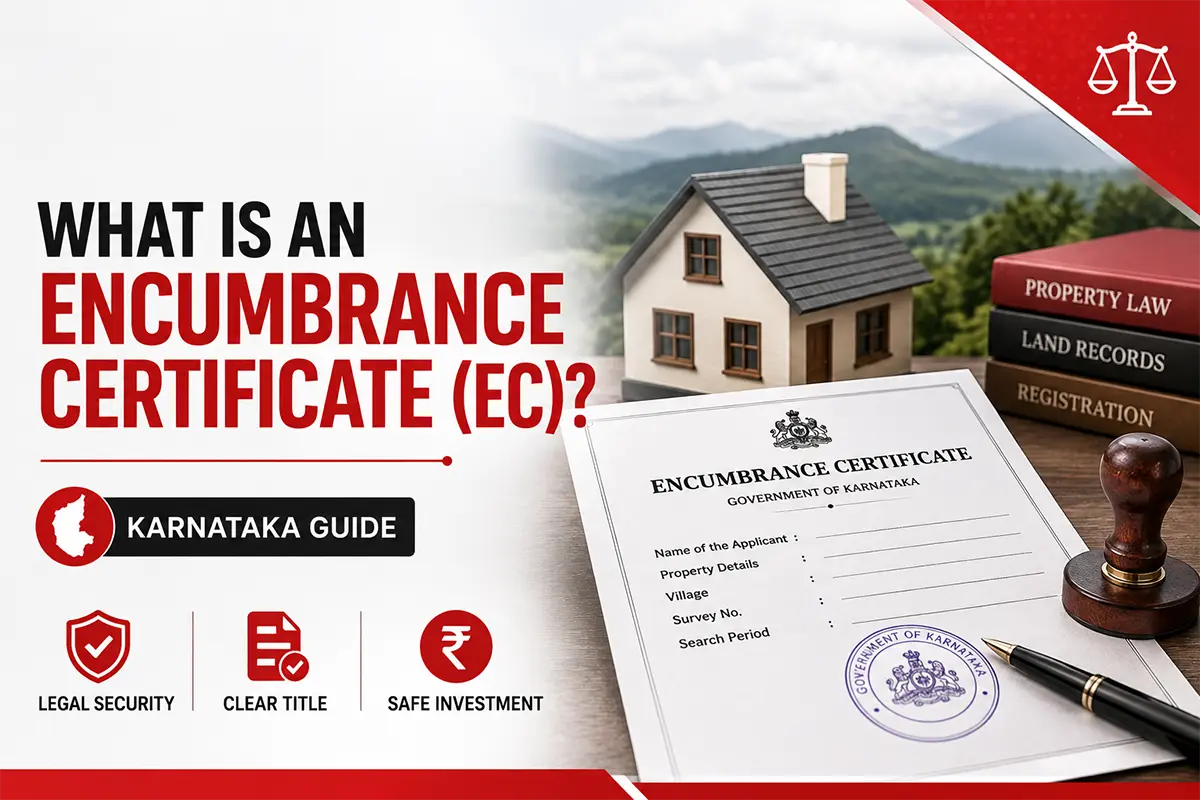
If you are buying land or property in Karnataka, one of the documents you will commonly hear about is the Encumbrance Certificate, or EC.
An EC is an important registration-related record that can help you understand registered transactions and encumbrances recorded against a property for a particular period.
For a buyer, the EC can be useful for identifying registered transactions such as sales, mortgages and other relevant entries. But a clean EC should not be treated as a complete guarantee that a property has no possible legal or title issue.
The EC is one part of a wider property due-diligence process.
Quick Answer: What is an Encumbrance Certificate?
An Encumbrance Certificate (EC) is a certificate or record relating to registered transactions and encumbrances recorded against a property for the period covered by the search.
In Karnataka, EC-related services are associated with the Department of Stamps and Registration and the Kaveri system. Karnataka government material identifies the EC as an information service relating to transactions and charges against properties.
For a property buyer, an EC can help you check whether relevant registered transactions or charges appear in the registration records for the property during the period searched.
What does "encumbrance" mean?
An encumbrance is a claim, liability, charge or other registered interest that can affect property.
In practical property transactions, buyers may be concerned about matters such as:
Mortgages
Registered property transactions
Certain charges
Releases related to previous transactions
Other registered interests affecting the property
The exact information shown depends on the records available and the period searched.
This is why an EC should be read carefully rather than treated simply as a certificate saying "no problems."
Why is an EC important when buying property?
Suppose you are planning to buy a property from a seller.
The seller gives you a Sale Deed showing that they own the property.
You also check the RTC/Pahani and mutation records where applicable.
The EC gives you another source of information from the registration records.
You can compare:
Sale Deed → Ownership history
RTC/Pahani → Revenue records
Mutation → Changes in revenue records
EC → Registered transactions and encumbrances for the searched period
Looking at these records together gives you a more useful picture than relying on a single document.
What information can an EC show?
The exact contents depend on the property and the period searched, but an EC can contain information relating to registered transactions or encumbrances.
These may include transactions such as:
Sale
Mortgage
Gift
Release
Partition
Other registered instruments or entries, where applicable
The Karnataka government has described the EC service as an information service concerning transactions and charges against properties.
Does an EC show the property's complete legal history?
Not necessarily.
This is one of the most important points for buyers to understand.
An EC relates to the registration records covered by the search. It should not automatically be interpreted as a complete record of every possible claim, dispute, agreement or legal issue affecting a property.
For example, a matter that was never registered may not appear in the EC.
Therefore:
No entry in an EC does not automatically mean there can be no other legal issue affecting the property.
This is why title documents, revenue records, court-related information where relevant and professional legal review may also be necessary.
Is a clean EC enough to buy property?
No.
A clean EC can be a useful part of property due diligence, but it should not be treated as a complete title certificate.
A buyer should also examine relevant:
Sale Deed
Previous ownership documents
RTC/Pahani, where applicable
Mutation records
Survey records
Land-use or conversion records, where applicable
Property tax or Khata records, where applicable
Layout and approval documents, where applicable
Seller identity and authority documents
The exact documents required depend on the property and its history.
Why is the EC period important?
An EC is searched for a particular period.
This means you should pay attention to the start date and end date of the search.
Suppose an EC covers only a short recent period.
It may not tell you what happened to the property before that period.
For a buyer trying to understand the property's transaction history, the relevant search period should therefore be considered carefully.
Do not simply ask:
"Is there an EC?"
Ask:
"What period does the EC cover?"
How far back should you check the EC?
There is no single period that should be blindly applied to every property transaction.
The appropriate period can depend on:
Property history
Previous transactions
Type of property
Available ownership documents
The purpose of the search
Professional legal advice
Instead of treating a fixed number of years as a universal rule, the buyer should examine the relevant ownership history and obtain a search period appropriate to the transaction.
If the property's ownership history goes back much further than the EC period, the earlier registered documents should also be examined.
What is a "Nil EC"?
A Nil EC generally refers to an EC in which no relevant registered encumbrance or transaction appears for the period searched.
However, the word "Nil" should not be misunderstood as:
"This property has absolutely no legal issue."
A Nil EC means that the relevant search did not show the applicable registered entries covered by that search.
It does not eliminate the need to examine the property's title and other records.
What is the difference between EC and Sale Deed?
The two documents serve different purposes.
Sale Deed
The Sale Deed records a sale transaction and the transfer of ownership through the registered instrument required by applicable law.
Encumbrance Certificate
The EC provides information about registered transactions and encumbrances recorded for the property during the period searched.
In simple terms:
Sale Deed → A particular ownership transaction
EC → Registered transaction/encumbrance information for a searched period
Both can be important when checking a property.
What is the difference between EC and RTC?
RTC/Pahani and EC come from different parts of the property-record system.
RTC / Pahani
RTC/Pahani is a revenue record associated with land rights, tenancy and crop-related information.
EC
EC relates to registered transactions and encumbrances recorded for the searched period.
For a land buyer, these records are complementary.
A simplified comparison is:
Record | Main purpose |
|---|---|
RTC / Pahani | Revenue-record information |
Mutation | Changes recorded in revenue records |
EC | Registered transactions and encumbrances for the searched period |
Sale Deed | Registered sale transaction |
Survey records | Property identification and survey details |
What is the difference between EC and Mutation?
Mutation and EC also serve different purposes.
Mutation relates to changes recorded in the revenue records.
EC relates to registered transactions and encumbrances recorded for the relevant search period.
For example, if a property was sold, the transaction may have registration records and may also result in changes to the revenue records.
The buyer should compare the relevant records rather than assuming that one automatically confirms the other.
How do you get an EC in Karnataka?
EC-related services are available through Karnataka's registration system, including Kaveri.
Karnataka government and government-related material identifies Kaveri as the online platform for property registration and EC-related services.
The exact online process can change, so buyers should use the current official Kaveri service rather than relying on an old step-by-step guide.
Depending on the service, property identification details may be required to search for the relevant record.
These can include information such as:
District
Sub-Registrar Office
Village
Property details
Survey Number
Document details
Relevant dates or search period
The information required can vary according to the property and service.
Can you check EC online in Karnataka?
Yes, Karnataka provides online EC-related services through its registration system.
The current Kaveri system provides registration-related digital services, and government material identifies EC as one of the information services associated with the platform.
Before downloading or relying on an EC, make sure that the property identifiers and search period are correct.
A document for the wrong property or wrong period is not useful simply because it is an official document.
How should you read an EC?
Do not just look for the words "Nil" or "No Encumbrance."
Read the document carefully.
Step 1: Check the property details
Make sure the EC relates to the property you are actually buying.
Check the available:
Property identifiers
Survey details
Location details
Relevant document references
Step 2: Check the search period
Confirm the start and end dates.
Step 3: Look at the transaction entries
If transactions appear, identify:
Date
Nature of transaction
Parties involved
Document details
Property reference
Step 4: Compare with the ownership documents
If the seller says they acquired the property through a particular Sale Deed, check whether the corresponding registration information is consistent with the EC.
Step 5: Investigate unexpected entries
If you find a mortgage, earlier sale, release or another unexpected entry, ask for the relevant supporting documents.
What should you check in an EC before buying property?
A buyer should check:
Correct property
Correct search period
Registered transactions
Seller and previous owner names
Mortgage-related entries, where recorded
Release or discharge-related entries, where applicable
Sale transactions
Gift or partition-related entries, where applicable
Other relevant registered entries
Consistency with the ownership documents
Do not stop at the first page if the document contains multiple transaction entries.
What if the EC shows a mortgage?
Do not automatically assume that the property cannot be sold.
Instead, investigate the mortgage and its current status.
Ask for appropriate documentation showing whether the loan has been:
Repaid
Released
Closed
Otherwise resolved
The exact documents depend on the lender and transaction.
If a mortgage appears and the seller cannot provide satisfactory supporting documentation, seek professional legal advice before proceeding.
What if an old mortgage appears in the EC?
An old mortgage entry does not necessarily mean that the property still has an outstanding loan.
There may have been a later release or discharge.
The important question is:
What happened after the mortgage was registered?
Check for the relevant subsequent documentation and entries.
Do not assume that an old entry is still active, but do not ignore it either.
What if the EC shows a previous sale?
This may simply reflect the property's ownership history.
For example:
Owner A → Sale → Owner B → Sale → Current Owner
The EC may show these registered transactions.
The buyer should compare them with the ownership documents and establish whether the current seller's ownership follows properly from the transaction history.
What if the EC does not show a transaction I know happened?
This needs investigation.
Possible explanations can include:
Incorrect property search details
Different property identifiers
Search-period limitations
Record availability issues
Data or registration-history issues
Do not assume that the transaction is irrelevant.
Check the registered document and the relevant registration records.
If necessary, seek clarification from the appropriate registration authority or professional advisor.
Can an EC reveal every property dispute?
No.
An EC should not be treated as a universal dispute-checking certificate.
It primarily relates to registered transactions and encumbrances within the relevant registration records and search period.
A dispute, claim or agreement that does not appear in those records may not necessarily appear in the EC.
This is one reason a comprehensive property due-diligence process can require more than an EC.
Can an EC prove clear title?
No.
An EC can support a property due-diligence process, but clear title is a broader question.
Title verification can require examination of:
Ownership documents
Previous ownership chain
Registered deeds
Revenue records
EC
Survey records
Court or dispute information where relevant
Land-use and conversion records where applicable
Other documents specific to the property
For complicated properties, a property lawyer can conduct a more comprehensive title review.
EC for agricultural land
If you are buying agricultural land, the EC is one of the documents worth checking.
You should consider it alongside:
RTC/Pahani
Mutation records
Sale Deed
Previous ownership documents
Survey records
Land-use or conversion records, where applicable
Do not assume that a clean EC by itself answers every question about agricultural land.
Agricultural-land transactions can involve additional legal considerations depending on the property's circumstances and intended use.
EC for residential plots
For a residential site or plot, the EC can help you examine registered transactions and encumbrances relating to the property for the searched period.
It should be considered along with:
Sale Deed
Parent documents
RTC/revenue records, where applicable
Mutation
Survey details
Conversion records, where applicable
Layout approvals, where applicable
EC for a house with land
If you are buying a house along with the underlying land, do not assume that checking the EC alone verifies every aspect of the property.
You may need to examine:
Land ownership
Building-related records
Property tax records
Applicable Khata records
Approvals
Registered transactions
Land-use status
The exact requirements depend on the property.
Common mistakes buyers make when checking EC
Mistake 1: Checking only whether the EC is "Nil"
A Nil EC is useful information, but it does not replace broader due diligence.
Mistake 2: Ignoring the search period
An EC only relates to the period covered by the search.
Mistake 3: Assuming an EC proves clear title
It does not.
Mistake 4: Checking EC but not the Sale Deed
The two documents serve different purposes.
Mistake 5: Checking EC but not RTC/Pahani
Revenue records provide a different perspective on the property.
Mistake 6: Ignoring an old mortgage
Find out whether it was later released or resolved.
Mistake 7: Accepting an EC for the wrong property
Always verify the property identifiers.
Mistake 8: Assuming unregistered claims will appear in the EC
An EC should not be treated as a complete record of every possible claim or dispute.
Mistake 9: Relying on a seller-provided screenshot
Where possible, obtain the relevant record through the appropriate official service and verify the property details and search period.
EC Checklist for Property Buyers
Before relying on an EC, check:
Correct property
Correct property identifiers
Correct search period
Seller's name
Previous owner names
Sale transactions
Mortgage entries
Release or discharge entries, where applicable
Gift or partition transactions, where applicable
Other relevant registered transactions
Consistency with the Sale Deed
Consistency with the ownership chain
Consistency with other property records
If something unexpected appears, investigate it before proceeding.
EC and Property Due Diligence: A Simple Workflow
A practical way to approach an EC is:
Step 1: Identify the property
Confirm the Survey Number, Hissa, location and other available identifiers.
Step 2: Obtain the relevant EC
Use the appropriate official registration service.
Step 3: Confirm the search period
Make sure the period is appropriate for the property's history.
Step 4: Read the transaction entries
Do not simply look for "Nil."
Step 5: Compare the EC with the Sale Deed
Check whether the transaction history makes sense.
Step 6: Compare with previous ownership documents
Look for gaps or unexplained transactions.
Step 7: Compare with RTC/Pahani and mutation records
Check whether the revenue and registration records tell a consistent story.
Step 8: Investigate anything unexpected
Do not proceed until significant discrepancies are understood.
Frequently Asked Questions
What is an Encumbrance Certificate?
An Encumbrance Certificate, or EC, is a registration-related record showing registered transactions and encumbrances recorded against a property for the period covered by the search.
What does EC stand for?
EC stands for Encumbrance Certificate.
Is an EC mandatory for buying property?
The exact documentation required can vary according to the transaction and property. An EC is an important document commonly used for property due diligence, but buyers should verify the current requirements applicable to their specific transaction.
Is a Nil EC enough to buy property?
No.
A Nil EC means that the relevant search did not show the applicable registered entries for the period searched. It does not guarantee that the property has no other possible legal or title issue.
How long should an EC be checked?
There is no single search period that should be treated as a universal rule for every property. The appropriate period depends on the property's ownership history and the purpose of the due-diligence exercise.
Can I get an EC online in Karnataka?
Karnataka provides online EC-related services through its registration system. Use the current official Kaveri service and verify the property details before relying on the record.
Does EC show loans?
An EC may show registered mortgage or other encumbrance-related entries for the property during the relevant search period. It should not be treated as a complete record of every possible loan or financial claim.
Does EC show ownership?
An EC can contain registered transaction information that helps a buyer understand the property's transaction history, but it should not replace examination of the Sale Deed and complete ownership chain.
Does EC show court cases?
Do not assume that every court case or property dispute will appear in an EC. The EC should not be treated as a complete litigation search.
What if an old mortgage appears in the EC?
Check whether there is a subsequent release, discharge or other document showing how the mortgage was resolved. If the status remains unclear, seek professional advice before proceeding.
Should I check EC before paying an advance?
Yes. EC verification should form part of your property due diligence before making a significant financial commitment.
Is EC the same as RTC?
No.
RTC/Pahani is a revenue record, while EC relates to registered transactions and encumbrances for the searched period. They provide different information and should be checked together.
Final Takeaway
An Encumbrance Certificate is one of the most useful registration-related records for a property buyer, but its value depends on how carefully you use it.
Do not simply ask whether the property has an EC.
Check:
What property does it relate to?
What period does it cover?
What transactions appear?
Do those transactions match the ownership documents?
Are mortgages or other entries properly resolved?
Does the EC agree with the RTC/Pahani, mutation records and Sale Deed?
Most importantly, remember that an EC is not a complete title certificate.
It is one part of a broader property due-diligence process.
If an EC contains an unexpected transaction, mortgage or other entry, investigate it before proceeding. For complicated ownership or title issues, professional legal verification is advisable.
This article is for general educational purposes and is not legal advice. Government services, procedures and applicable rules can change, so buyers should verify current information through the relevant Karnataka authorities before relying on it for a property transaction.