Buying land in Sagara is a decision that deserves careful checking before you pay an advance.
A parcel may look suitable during a site visit, but that alone does not tell you whether the seller has clear ownership, whether the recorded land details match the property, whether the boundaries are correct, or whether you can legally use the land for your intended purpose.
Sagara is a taluk in Shivamogga district, Karnataka. The taluk includes urban and rural areas, so the exact location and administrative jurisdiction of a property matter when you are checking land records, access, approvals and other property-related information.
Whether you are considering agricultural land, a residential site, or another type of land, the basic principle is the same:
Check the land, check the documents, check the seller and check the permitted use before you commit.
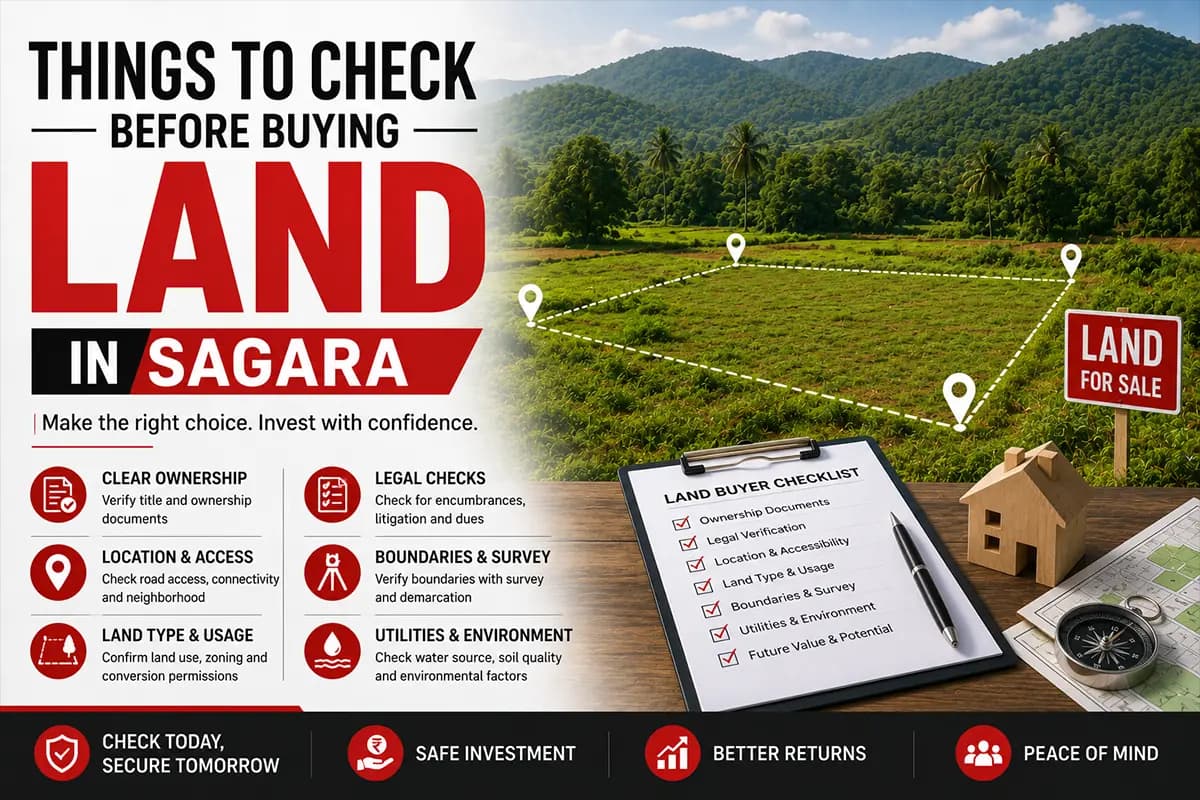
Quick Answer: What Should You Check Before Buying Land in Sagara?
Before buying land in Sagara, check:
The exact survey number and property location
The seller's ownership
Sale deed and previous title documents
RTC/Pahani where applicable
Mutation records where applicable
Encumbrance records
Land extent and survey details
Physical boundaries
Legal and practical road access
Water availability
Land classification and permitted use
Existing structures and improvements
Encroachments or disputes
Government notices or restrictions
Applicable conversion or development requirements
Registration and transaction costs
Do not make an advance payment simply because the land looks good or the seller says the documents are clear.
Verify the important facts first.
1. Start by Identifying What Kind of Land You Are Buying
The word "land" can describe very different properties.
Before looking at individual listings, establish whether you are considering:
Agricultural land
A residential site
Converted land
Plantation land
Commercial land
Another type of property
Your intended use matters.
If you want to build a house, for example, do not assume that any parcel near Sagara can be used as a residential site.
If you want agricultural land, do not assume that a parcel advertised as farmland can automatically be used for construction or other non-agricultural purposes.
First identify the property's present status.
Then check whether that status is compatible with what you intend to do.
2. Get the Exact Survey Number
Do not start your due diligence with only a Google Maps location or a description such as "the land near the main road."
Ask for the property's:
Survey Number
Subdivision details, where applicable
Village
Hobli or other relevant administrative details
Taluk
District
Recorded extent
The survey number is particularly important because it helps connect the physical parcel to the relevant land records.
If the seller cannot clearly identify the survey details, treat that as a reason to investigate further before proceeding.
3. Verify the Seller's Ownership
The person showing you the land is not automatically the person legally entitled to sell it.
Ask:
Who owns the land?
How did the seller acquire it?
Is the seller the sole owner?
Are there co-owners?
Are there legal heirs?
Has the land been inherited?
Has it been divided through partition?
Has it previously been sold?
Review the relevant title documents and compare the names and property details across them.
If the ownership history is complicated, independent legal review is worth considering before making an advance.
4. Check the Sale Deed and Previous Title Documents
The current sale deed is only one part of the ownership history.
Depending on the property, you may need to review previous documents to understand how ownership moved from one person to another.
Look for consistency in:
Seller names
Buyer names
Survey number
Land extent
Boundaries
Property description
Dates
Registration details
If a previous document describes the land differently from the current document, ask why.
Do not ignore discrepancies simply because the seller says they are "normal."
5. Check RTC and Pahani
RTC stands for Record of Rights, Tenancy and Crops.
Pahani is a commonly used term for the RTC record in Karnataka.
For land where these records apply, compare the relevant RTC/Pahani information with the ownership documents.
Check details such as:
Recorded owner
Survey number
Extent
Land classification
Other relevant entries
Karnataka's Bhoomi system is used for land-record services and mutation-related information.
The important point is not simply obtaining an RTC copy.
You need to check whether the information is consistent with the other documents and with the physical property.
6. Check Mutation Records
Mutation refers to the recording of changes in relevant land records following a transaction or other qualifying event.
If the property has changed hands, check whether the relevant records reflect the transaction where applicable.
Compare mutation information with:
Sale deeds
RTC/Pahani
Ownership details
Survey information
Other title documents
Mutation should not be treated as a substitute for title verification.
It is one part of the overall document review.
7. Check the Encumbrance Certificate
An Encumbrance Certificate, commonly called an EC, is another important part of property due diligence.
Review the relevant EC information and compare it with the property's transaction history.
Look for registered transactions or other entries that require clarification.
However, do not treat an EC as a guarantee that the property has no possible legal issue.
An EC should be reviewed together with:
Title documents
Land records
Seller information
Survey details
Other relevant records
If you find a loan, mortgage or other issue that needs clarification, resolve it before proceeding.
8. Compare the Land Area Across Documents
The land area stated in an advertisement may not be the same as the legally documented extent.
Compare the area stated in:
Sale deed
RTC/Pahani
Survey records
Survey sketch, where applicable
Other relevant documents
Then compare it with the physical property.
If the numbers do not match, find out why.
Do not negotiate or make an advance based only on the seller's verbal measurement.
9. Check the Physical Boundaries
Walk the property if possible.
Look for:
Boundary stones
Fencing
Walls
Roads
Streams
Neighbouring properties
Existing structures
Signs of encroachment
Compare what you see with the available documents.
If the boundaries are unclear, consider getting a qualified survey professional to assist with the measurement and identification of the parcel.
This is particularly important for larger agricultural properties.
10. Check Road Access
A parcel can be close to a road without having straightforward access to it.
Ask:
Where is the access road?
Is it physically usable?
Does the road pass through another person's property?
Is there a documented right of way where required?
Can vehicles reach the land?
Can agricultural equipment reach it if necessary?
Do not assume that an existing track automatically gives you a permanent legal right to use it.
Access should be investigated before buying.
11. Check Water Availability
Water can be a major practical consideration, especially for agricultural land.
Depending on the property, ask about:
Wells
Borewells
Streams
Irrigation
Storage tanks
Water-sharing arrangements
Seasonal availability
Do not assume that the presence of a well or borewell means the land has sufficient water throughout the year.
If your intended use depends heavily on water, inspect the existing system and consider appropriate technical advice.
12. Check the Land Classification
Establish what the land is currently recorded as.
This matters because ownership and permitted use are not the same thing.
For example, agricultural land should not automatically be treated as a residential plot simply because:
It is near a town
Houses are nearby
There is road access
A seller says it can be converted
A broker describes it as "future residential land"
Karnataka's land-revenue framework contains provisions governing the use of agricultural land and diversion for other purposes.
If your intended use differs from the existing agricultural use, verify the applicable requirements before purchasing.
13. Be Careful About Conversion Claims
One of the most common statements in land advertisements is:
"Can be converted."
That statement should not be accepted without verification.
If you intend to use agricultural land for a non-agricultural purpose, investigate:
Whether the proposed use is permitted
Whether conversion or diversion is required
Which authority is responsible
Whether a master plan or other planning document affects the property
Whether additional approvals are required
What conditions apply
Karnataka's Land Revenue Act contains provisions relating to diversion of agricultural land for other purposes.
The applicable process can depend on the property and proposed use, so check the current rules before relying on a conversion claim.
14. Check for Existing Structures
If the land contains:
A house
Farm building
Shed
Storage structure
Pump house
Other construction
do not automatically assume that every structure is authorised.
Ask:
Who constructed it?
When was it constructed?
What is it used for?
Is it reflected in relevant records?
Are applicable permissions available?
This becomes particularly important if the existing structure is part of the reason you are interested in the property.
15. Check for Encroachments
An encroachment can involve more than a neighbour occupying part of your land.
Look for:
Fences extending into the parcel
Structures crossing boundaries
Roads or paths cutting through the land
Cultivation extending beyond apparent boundaries
Water channels
Other physical occupation
Compare the physical situation with the available records.
If you find a potential encroachment, resolve the issue before purchasing rather than assuming it can be sorted out later.
16. Ask About Existing Cultivation or Tenancy
If the land is agricultural, find out whether someone else is currently using it.
Ask whether the property is:
Cultivated by the owner
Cultivated by another person
Leased
Managed by another party
Subject to an existing arrangement
If another person is cultivating the land, understand the legal and contractual position before purchasing.
Do not assume that the person working on the land will automatically stop after the sale.
17. Check for Disputes and Claims
Ask whether the land is involved in:
Court proceedings
Family disputes
Boundary disputes
Inheritance disputes
Government notices
Acquisition proceedings
Encroachment disputes
Access disputes
Other claims
Do not rely only on the seller's verbal answer.
Where the purchase is significant or the ownership history is complicated, independent legal due diligence can help identify issues that may not be obvious from a site visit.
18. Check the Local Jurisdiction
Sagara taluk includes multiple Gram Panchayats, while Sagara town has a City Municipal Council.
The Shivamogga district administration currently lists 35 Gram Panchayats under Sagara taluk.
That matters because the relevant local authority can depend on the property's exact location.
Before buying, establish:
Village
Gram Panchayat or municipal jurisdiction
Taluk
District
Relevant local authority
Do not assume that two properties marketed as being "in Sagara" necessarily fall under the same local administrative process.
19. Check the Land Against the Actual Site
Documents and site conditions should tell the same story.
Compare:
Documents
Survey number
Extent
Boundaries
Classification
Ownership
with:
Physical property
Location
Boundaries
Size
Access
Existing structures
Current use
If the two do not match, investigate before proceeding.
This is one of the most important checks because a document review conducted without visiting the actual property can miss physical problems.
20. Do Not Assume Future Development Potential
A parcel may be advertised as:
Near a proposed road
Near a future development
Suitable for sites
Good for investment
Likely to appreciate
Ideal for a farmhouse
These are claims, not guarantees.
If future development is important to your decision, verify the relevant planning information through appropriate official sources.
Do not pay a premium simply because someone says that a particular area will soon become residential or commercial.
21. Check the Total Purchase Cost
The agreed land price is not necessarily your total cost.
Depending on the transaction, you may also need to account for:
Stamp duty
Registration charges
Legal due diligence
Survey expenses
Fencing
Access improvements
Water infrastructure
Irrigation
Existing structure repairs
Other property-related expenses
Government charges can change, so verify the applicable current charges before registration.
Do not rely on an old percentage quoted by a broker or found in an older article.
22. Documents to Check Before Buying Land in Sagara
The exact document set depends on the property, but your due-diligence list may include:
Sale deed
Previous title documents
RTC/Pahani
Mutation records
Encumbrance Certificate
Survey records
Survey sketch where applicable
Ownership documents
Partition or inheritance documents where applicable
Relevant land-use or conversion records
Property or revenue records where applicable
Documents relating to existing structures
The goal is not to collect paperwork for its own sake.
The goal is to establish a consistent chain:
Who owns the land → what land is being sold → where it is → how much land exists → what use is permitted → whether any claims or restrictions exist.
23. Questions to Ask the Seller
Before making an offer, ask:
Why are you selling?
How did you acquire the land?
How long have you owned it?
Are you the sole owner?
Are there co-owners or legal heirs?
Is anyone cultivating the land?
Is the land leased?
Is there an existing loan or mortgage?
Are there any disputes?
How is the property accessed?
What is the water source?
Are there existing structures?
Has any part of the land been converted?
Are all original documents available?
Are there any government notices?
Then verify the answers against the documents.
24. Do Not Pay an Advance Too Early
An advance payment should come after basic due diligence, not before it.
Before making a significant payment, try to establish:
Seller identity
Ownership
Survey identity
Land extent
Boundaries
Access
Land classification
Major encumbrances
Known disputes
Intended-use requirements
If important questions remain unanswered, pause.
A low asking price is not a reason to skip verification.
25. What If You Want to Build a House on the Land?
This question deserves special attention.
If your real objective is to buy land now and construct a house later, do not automatically search only for agricultural land.
Consider whether the property is already suitable for your intended residential use.
If you are considering agricultural land, investigate the applicable land-use and conversion requirements before purchasing.
The Karnataka Land Revenue Act regulates the use of agricultural land and contains provisions dealing with diversion to other purposes.
Your intended construction may also involve separate planning and building requirements.
Therefore, "I will convert it later" should never be treated as a guaranteed plan.
26. What If You Want Agricultural Land?
If your intention is genuinely agricultural, evaluate the land based on its agricultural suitability.
Check:
Water
Soil and terrain
Existing cultivation
Access
Drainage
Fencing
Labour access
Existing irrigation
Farm structures
Maintenance requirements
Do not assume that every large parcel is equally suitable for farming.
The quality and suitability of the individual property matter more than the size alone.
27. A Practical Land-Buying Checklist for Sagara
Property Identity
Survey number confirmed
Village confirmed
Exact location confirmed
Land extent confirmed
Subdivision details checked where applicable
Seller
Seller identity verified
Ownership established
Co-owners identified
Inheritance or partition issues checked
Previous title documents reviewed
Land Records
RTC/Pahani checked where applicable
Mutation checked where applicable
EC checked
Survey records checked
Land extent compared
Land classification checked
Site Inspection
Boundaries inspected
Access road checked
Water source checked
Existing structures inspected
Encroachments checked
Neighbouring land checked
Current land use observed
Legal and Land Use
Disputes investigated
Claims investigated
Government notices checked where relevant
Conversion requirements investigated where applicable
Intended use confirmed as legally feasible
Purchase
Total cost calculated
Current government charges verified
Agreement terms understood
Advance terms documented
Final documents reviewed
Registration process confirmed
28. Common Mistakes to Avoid
Buying Because the Price Looks Low
A low price can have an explanation. Find it before assuming you have found a bargain.
Trusting Only the Seller's Documents
Ask questions and compare the available records.
Skipping the Site Visit
A document cannot show you every physical problem.
Ignoring Boundaries
Boundary issues can become difficult to resolve after purchase.
Assuming Road Access
Check both physical access and the legal basis for access where necessary.
Assuming Water Is Guaranteed
Inspect the actual water source and understand its practical reliability.
Buying Agricultural Land for a House Without Checking Conversion
Land ownership does not automatically mean unrestricted development rights.
Believing Future Development Claims
Verify proposed infrastructure and planning information instead of relying on promises.
Paying an Advance Before Due Diligence
Resolve major questions first.
Using Outdated Legal Information
Land rules can change. Check the current position before making a transaction.
29. The Simple Land-Buying Process
A practical process is:
1. Decide what you want the land for
↓
2. Shortlist suitable properties
↓
3. Get the exact survey details
↓
4. Visit the property
↓
5. Check boundaries, access and water
↓
6. Verify the seller and title
↓
7. Check RTC/Pahani, mutation and EC where applicable
↓
8. Check land classification and permitted use
↓
9. Investigate disputes and restrictions
↓
10. Resolve discrepancies
↓
11. Negotiate the purchase
↓
12. Complete the agreement and registration process
The most important principle is simple:
Do not buy the paperwork or the promise. Buy only after you understand the actual land.
Frequently Asked Questions
What should I check first before buying land in Sagara?
Start with the exact survey number, seller identity, ownership documents, land extent and location.
Then compare the records with the physical property.
What documents should I check before buying land in Sagara?
Depending on the property, you may need to review the sale deed, previous title documents, RTC/Pahani, mutation records, EC, survey information and relevant land-use records.
Is RTC enough to verify land ownership?
No.
RTC is an important land record, but it should be reviewed alongside title documents, mutation information, survey details and other relevant records.
How do I check whether the land boundaries are correct?
Compare the available survey and property records with the physical boundaries.
If there is uncertainty, consider an independent survey.
How important is road access when buying land?
It can be extremely important.
Check how the property is physically accessed and whether the access has an appropriate legal basis where necessary.
What should I check if the land is agricultural?
Check the land classification, RTC/Pahani, ownership, water, access, boundaries, existing cultivation, encumbrances and any restrictions affecting your intended use.
Can I buy agricultural land and build a house later?
Do not assume that you can.
Check the applicable land-use, conversion and building requirements for the specific property before buying it for future construction.
Should I check water before buying agricultural land?
Yes.
If farming or plantation use is important to you, water availability should be one of the first practical checks.
Should I hire a lawyer before buying land?
For a significant transaction, independent legal due diligence can be valuable, particularly where there are multiple owners, inheritance issues, old documents, boundary concerns or land-use questions.
Should I pay an advance before checking the documents?
It is safer to complete basic due diligence first.
If major questions remain unresolved, do not rush into an advance payment.
Is land near Sagara town automatically a good investment?
Not necessarily.
Land value and suitability depend on the individual property's location, legal status, access, permitted use, physical characteristics and market conditions.
Do not buy based only on assumptions about future appreciation or development.
Final Thoughts
Buying land in Sagara should start with verification, not negotiation.
Before you decide whether a parcel is worth the asking price, establish:
Who owns it?
What exactly is being sold?
Do the records match the land?
Are the boundaries and access clear?
What can the land legally be used for?
Are there any disputes, claims or restrictions?
What will the purchase actually cost?
Once these questions have been answered, you can make a much more informed decision.
A good land purchase is not simply about finding the right location or getting a good price.
It is about making sure the land you are buying is the land you think you are buying, with the ownership, records, access and permitted use properly understood before you commit.