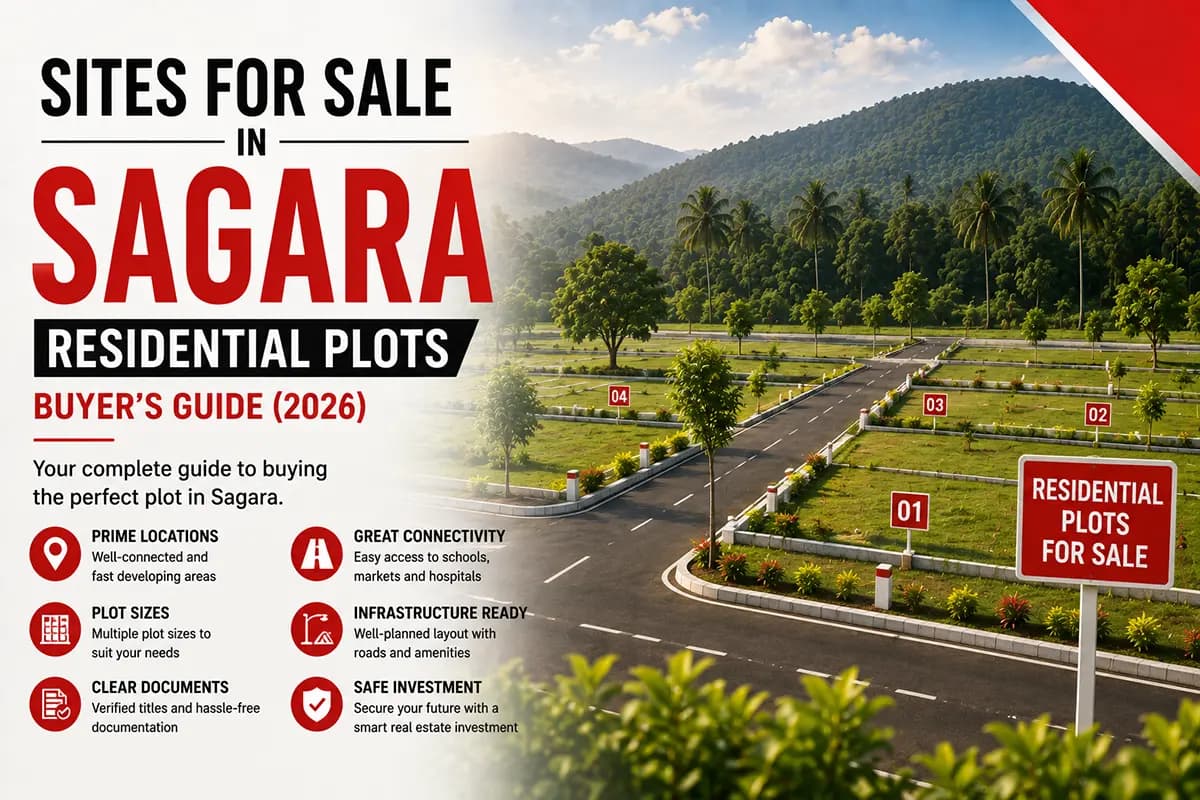

Property in Sagara: A Complete Guide for Buyers
If you are looking for property in Sagara, the first step is not choosing a property. It is understanding what you are actually buying, where it is located, how it can be used, and whether the documents support the seller's claims.
Sagara is a taluk in Shivamogga district, Karnataka. The Shivamogga district administration currently lists Sagara as one of the district's seven taluks.
For a property buyer, that local context matters. A property in Sagara town, a residential site outside the town, and agricultural land elsewhere in the taluk can have very different documentation, access, permitted uses and buying considerations.
This guide explains how to approach a property purchase in Sagara without relying on assumptions about prices or future returns.
Quick Answer: What Should You Know Before Buying Property in Sagara?
Before buying property in Sagara, identify the property type and intended use, verify the location and physical boundaries, examine the relevant land and property records, check applicable approvals or conversion requirements, and have the documents reviewed before committing to the transaction.
The main property categories you may come across include:
• Houses and residential properties
• Residential plots or sites
• Agricultural land
• Farm or plantation properties
• Commercial properties
The right choice depends on whether your purpose is to live in the property, construct a house, use land for agriculture, operate a business, or pursue another permitted use.
Do not judge a property only by its asking price or appearance. Title, land classification, access, boundaries, permitted use and documentation can be just as important as the property itself.
What Types of Property Can You Buy in Sagara?
"Property in Sagara" can refer to several different types of real estate. These should not be treated as interchangeable.
Houses and Residential Properties
An existing house may suit a buyer who wants to occupy the property without going through the entire construction process.
Before buying, look beyond the building itself. Check:
• Ownership and title
• Land records
• Survey details
• Property boundaries
• Building-related records where applicable
• Access to the property
• Water and electricity arrangements
• Existing dues or liabilities
• Physical condition of the building
A well-maintained house with weak documentation is not necessarily a safer purchase than an older house with clear records.
Residential Plots or Sites
A residential plot can be suitable if your intention is to construct a house later.
The key question is not simply whether a seller calls something a "site." You should verify the property's actual classification, title, survey details, access and applicable approvals before proceeding.
For plotted developments, also examine the layout and project-related approvals that apply to the particular property.
Agricultural Land
Agricultural land is a different category from a residential plot.
If you are considering agricultural land in or around Sagara, verify its land records, boundaries, access, intended use and applicable legal requirements.
Do not assume that agricultural land can automatically be used for constructing a residential building. Land-use and conversion requirements can depend on the applicable law and the circumstances of the property.
The Karnataka Land Revenue Act contains provisions concerning diversion of agricultural land for other purposes. Buyers should verify the current requirements before treating agricultural land as a house site.
Farm or Plantation Properties
A farm or plantation property can combine land ownership with agricultural or plantation use.
Here, physical inspection becomes particularly important.
Check:
• Actual extent of land
• Survey boundaries
• Road access
• Water availability
• Existing structures
• Land classification
• Neighbouring land
• Any restrictions affecting intended use
Do not assume that the presence of a house, shed or other structure automatically establishes that the entire property can legally be used for residential purposes.
Commercial Property
Commercial property may include shops, offices, buildings or other properties intended for commercial use.
The buyer should verify:
• Permitted use
• Title
• Access
• Building-related approvals
• Existing tenancy arrangements
• Existing liabilities or dues
Which Type of Property in Sagara Is Right for You?
Your purpose should determine the type of property you investigate.
Your Goal | Property Type to Investigate |
|---|---|
Move into a home | Existing residential property |
Build your own home | Residential plot or site |
Grow crops | Agricultural land |
Manage a farm or plantation | Appropriate agricultural or plantation property |
Run a business | Commercial property or property with permitted commercial use |
Hold property for the future | Depends on property type, legal status, location and intended use |
This is only a starting point. A property should be evaluated on its actual legal and physical characteristics rather than its label in an advertisement.
What Is Sagara Like as a Property Location?
Sagara is part of Shivamogga district in Karnataka and is officially recognised as one of the district's taluks.
The Shivamogga district administration currently lists 35 Gram Panchayats under Sagara. These include places such as Anandapura, Heggodu, Keladi, Talaguppa, Tumari and several other local administrative areas.
This is important for buyers because the wider Sagara taluk covers more than the town itself. A property described simply as being "in Sagara" can therefore have a very different local setting depending on its exact location.
Karnataka Tourism describes Sagara as being in the Malnad belt of Shivamogga district and identifies its connection with places such as Jog Falls, the Sharavathi backwaters, Ikkeri and Keladi. It also identifies Sagar Jambagaru and Talaguppa as rail access points.
For a property buyer, these facts provide geographic context. They should not automatically be treated as evidence of property appreciation or investment returns.
Which Areas of Sagara Should You Consider?
There is no single "best area" for every property buyer.
The right location depends on what you want from the property.
If You Want a Home
You may prioritise:
• Access to everyday services
• Road connectivity
• Water and electricity
• Neighbourhood character
• Travel time to work or other regular destinations
• Existing residential development
If You Want a Plot
You should additionally examine:
• Road width and actual access
• Plot dimensions
• Survey boundaries
• Neighbouring development
• Applicable layout approvals
• Availability of utilities
• Future construction requirements
If You Want Agricultural Land
Your priorities will be different:
• Land classification
• Access
• Water
• Terrain
• Existing cultivation
• Survey boundaries
• Neighbouring land
• Intended agricultural use
If You Are Considering Property Outside the Town
Do not judge distance by a listing description alone.
Visit the property and assess:
• The actual route
• Road condition
• Physical access
• Surrounding development
• Nearby land use
The Sagara taluk is geographically broader than Sagara town, so the phrase "property in Sagara" can cover properties with very different local characteristics.
How Much Does Property Cost in Sagara?
There is no single price that accurately represents property prices in Sagara.
A house, residential site, agricultural parcel and commercial property are different markets. Even two properties of the same type can have substantially different values because of their exact location, size, access, title, land classification, development and physical condition.
When comparing properties, look at:
• Property type
• Land or plot area
• Built-up area
• Exact location
• Road access
• Land classification
• Conversion status where applicable
• Water and electricity
• Documentation
• Existing structures
• Applicable approvals
• Additional purchase costs
Do Not Compare Properties Only by Total Price
For example, a lower-priced property may require additional expenditure for access, construction, documentation, approvals or other work.
A higher-priced property may have characteristics that make it more suitable for your intended use.
The useful comparison is therefore not:
Which property is cheaper?
It is:
Which property gives me the right combination of legal clarity, location, usability, condition and total cost for my purpose?
What Documents Should You Check Before Buying Property in Sagara?
Property documentation should be reviewed before you commit to a purchase.
Depending on the property, relevant records may include:
Sale Deed
The sale deed is the document used to record the transfer of ownership through the sale transaction.
Review the document history and make sure the seller's claimed ownership is consistent with the available records.
RTC / ಪಹಣಿ
RTC is a land record associated with land details in Karnataka. Buyers of land should understand the relevant RTC information for the property being considered.
The relevant land records should be checked as part of broader property due diligence.
Encumbrance Certificate
An Encumbrance Certificate, commonly called an EC, can be used in property-related verification to examine registered transactions or encumbrances reflected in the relevant records for the period covered by the certificate.
An EC should not be treated as the only title check.
Mutation
Mutation refers to updating relevant revenue records following changes in rights or ownership.
A buyer should check the relevant mutation history and understand how it relates to the property records.
Survey Records
The survey number, extent and boundaries should correspond with the documents and the property you physically inspect.
This is particularly important for land purchases.
Khata and Related Municipal Records
Where applicable, buyers should examine the relevant municipal or local-body property records.
The exact records required can differ according to the property and its location.
Conversion Records
If land was originally agricultural and is intended for a non-agricultural use, check the applicable conversion or land-use requirements.
Do not assume that a seller's statement that land is "converted" is sufficient. Verify the relevant documentation.
Why the Survey Number Matters
A property description can look straightforward on paper while being difficult to identify on the ground.
The Survey Number / ಸರ್ವೆ ನಂಬರ್ helps connect the documentary description of land with its location and extent.
During due diligence, compare:
• Survey number
• Land extent
• Boundaries
• Location
• Revenue records
• Sale documents
• Physical property
If these details do not align, pause the transaction and obtain professional advice before proceeding.
What Should You Check During a Property Site Visit?
A site visit should be more than looking at the house, plot or landscape.
Use this checklist.
1. Confirm the Exact Location
Make sure the property you are visiting is the same property described in the documents and transaction discussions.
2. Check Access
Ask:
• Is there a proper road?
• Is the access physically usable?
• Is the access reflected in the relevant documents?
• Does the route depend on someone else's private land?
3. Check the Boundaries
Compare physical boundaries with the survey and property records.
4. Check the Surrounding Land
Look at neighbouring properties and current land use.
5. Check Water
For a house, farm or land purchase, understand how water is currently supplied and whether claims about water availability can be verified.
6. Check Electricity and Other Utilities
Do not assume that a nearby electricity line means the property already has the required connection.
7. Look at the Property in Different Conditions Where Possible
For land in the Malnad region, physical conditions can vary with weather.
If practical, ask questions about access and drainage during heavy rainfall rather than judging the property only on a dry-day visit.
8. Check for Physical Mismatches
If the property appears smaller, differently shaped or differently located than the documents suggest, stop and investigate.
What Additional Costs Should You Budget For?
The purchase price is not necessarily the total cost of acquiring a property.
Depending on the transaction, you may need to account for:
• Stamp duty
• Registration charges
• Legal review
• Documentation expenses
• Survey-related expenses
• Brokerage, where applicable
• Loan-related costs
• Renovation or construction
• Applicable taxes or dues
Stamp duty and registration-related charges are governed by applicable laws and rules, and rates or processes can change.
Before making a financial commitment, verify the current charges applicable to your specific transaction.
What If You Are Buying Agricultural Land in Sagara?
Agricultural land requires additional care because the property's existing classification and your intended use matter.
Before buying, check:
• RTC / ಪಹಣಿ
• Survey number
• Extent
• Boundaries
• Ownership
• Encumbrances
• Access
• Water
• Existing cultivation
• Land classification
• Intended use
• Applicable conversion or land-use requirements
The Karnataka Land Revenue Act contains provisions concerning diversion of agricultural land for other purposes. The applicable legal process should therefore be checked against the current law and the specific property circumstances.
Do not buy agricultural land on the assumption that you can automatically construct a residential property on it.
What If You Are Buying a Plotted Development?
A plotted development needs its own due-diligence process.
Check:
• Who owns the underlying land?
• Is the title clear?
• What is the survey number?
• Is the layout approved as required?
• What is the applicable land classification?
• Are the roads and access arrangements documented?
• What utilities are actually available?
• Are there project approvals or registrations that apply?
• Does the property being sold match the approved plan and documents?
If a project falls within the scope of applicable RERA requirements, verify its registration and project information through the appropriate official channel.
Do not rely only on a brochure or verbal assurance.
How to Compare Two Properties in Sagara
If you are deciding between two properties, use a simple comparison sheet.
Factor | Property A | Property B |
|---|---|---|
Property type | House / Plot / Land | House / Plot / Land |
Exact location | Enter location | Enter location |
Land / plot size | Enter size | Enter size |
Built-up area | Enter area | Enter area |
Road access | Good / Limited / Verify | Good / Limited / Verify |
Survey details | Verified / Pending | Verified / Pending |
Land classification | Enter classification | Enter classification |
Conversion status | Applicable / Not applicable / Verify | Applicable / Not applicable / Verify |
Documentation | Complete / Pending | Complete / Pending |
Utilities | Water / Electricity / Other | Water / Electricity / Other |
Physical condition | Good / Average / Needs work | Good / Average / Needs work |
Asking price | Enter amount | Enter amount |
Additional costs | Enter amount | Enter amount |
Intended use | Enter purpose | Enter purpose |
Legal review | Completed / Pending | Completed / Pending |
Use this table when comparing actual properties. It helps you evaluate more than just the asking price.
Step-by-Step Process for Buying Property in Sagara
Step 1: Define Your Purpose
Decide whether you want:
• A home
• A plot
• Agricultural land
• A farm or plantation property
• Commercial property
• Another permitted property use
Step 2: Set Your Total Budget
Do not limit the budget to the property's asking price.
Include likely transaction, legal, financing, construction or renovation costs.
Step 3: Shortlist Suitable Properties
Compare properties based on their actual characteristics.
Step 4: Visit the Property
Inspect the property and surrounding area physically.
Step 5: Request the Documents
Ask for the relevant ownership, land, registration and property records.
Step 6: Verify the Property
Check whether the documents, survey details, boundaries and physical property match.
Step 7: Check Applicable Permissions
This is especially important for agricultural land, converted land, plotted developments and properties involving construction.
Step 8: Obtain Professional Legal Advice
A qualified property lawyer can review the title and transaction documents and identify issues that a buyer may miss.
Step 9: Confirm the Transaction Costs
Verify applicable stamp duty, registration charges and other expenses before finalising the deal.
Step 10: Negotiate Only After Due Diligence
Price negotiation is more meaningful once you understand the property's legal and physical position.
Step 11: Complete the Transaction Through the Appropriate Process
Property registration and related documentation should be completed through the applicable legal and government processes.
Step 12: Keep the Records Safely
Retain copies of the final documents and relevant records after completion.
Common Mistakes Buyers Should Avoid
Buying Because the Price Looks Attractive
A low price does not compensate for unclear title, poor access or unsuitable land use.
Skipping the Site Visit
Photographs cannot confirm boundaries, access, surroundings or physical condition.
Treating RTC as the Only Document You Need
Property due diligence is broader than checking one record.
Assuming Agricultural Land Can Be Used as a Residential Site
Check the applicable land-use and conversion requirements first.
Relying Entirely on the Seller's Explanation
Ask for documents and verify important claims independently.
Ignoring Access
A property may appear attractive until you discover that the practical route is inadequate or legally unclear.
Comparing Only the Purchase Price
The real cost can include registration, legal review, construction, renovation and other expenses.
Rushing Because of a Deadline
If a seller creates pressure to pay a token amount immediately, take the time needed to understand what you are signing and what documents have actually been verified.
Is Sagara a Good Place to Buy Property?
There is no universal answer.
Sagara can be relevant to buyers looking for different types of property, including residential property and land, but whether a particular purchase is suitable depends on the buyer's purpose and the individual property.
A sensible assessment should consider:
• Why you are buying
• Where the property is located
• What the property can legally be used for
• Documentation
• Road access
• Utilities
• Surrounding development
• Total cost
• Your expected holding period
• Your ability to manage the property
Sagara's Malnad setting and connections to destinations such as Jog Falls, the Sharavathi backwaters, Ikkeri and Keladi are part of its broader geographic context.
These characteristics should not, by themselves, be treated as evidence of future property appreciation.
Should You Buy a House or a Plot in Sagara?
That depends on your timeline and intended use.
Choose an Existing House If:
• You want to occupy the property sooner
• You prefer an existing structure
• You want to avoid managing a new construction project
Consider a Plot If:
• You want to design and build your own house
• You have a longer timeline
• You are comfortable managing construction
• The plot's residential status and approvals are properly verified
Neither option is automatically better.
The right choice depends on your budget, intended use, timeline and the specific property.
Frequently Asked Questions
What Types of Property Are Available in Sagara?
Property in Sagara can include houses, residential plots, agricultural land, farm or plantation properties and commercial properties. The applicable due diligence differs by property type.
What Documents Should I Check Before Buying Property in Sagara?
Depending on the property, relevant documents and records may include the sale deed, RTC/Pahani, EC, mutation records, survey records, Khata or other local-body records, conversion documents and applicable approvals.
What Is RTC or Pahani?
RTC, commonly associated with the Pahani land record, is a land record used in Karnataka. Buyers should review the relevant record as part of broader property due diligence.
Do I Need an Encumbrance Certificate?
An EC can form part of property-document verification, particularly for examining registered transactions or encumbrances reflected in the relevant records for the period covered. It should not be treated as the only title check.
Can I Build a House on Agricultural Land in Sagara?
Do not assume that you can. Agricultural land use and diversion are governed by applicable Karnataka law, and the requirements depend on the circumstances. Verify the current rules and the property's specific status before proceeding.
How Should I Compare Property Prices in Sagara?
Compare properties based on type, exact location, size, access, legal status, documentation, utilities, condition and total purchase cost rather than looking only at the advertised price.
Should I Buy Property in Sagara for Investment?
That depends on the property, purchase price, intended holding period, risks and your financial objectives. Avoid assuming that a location automatically guarantees appreciation.
What Should I Check During a Property Site Visit?
Check the exact location, road access, boundaries, survey details, surrounding land use, water, electricity, drainage, physical condition and whether the property matches the documents.
Is Sagara Town the Same as the Entire Sagara Taluk?
No. Sagara is a taluk within Shivamogga district, while the wider taluk includes multiple Gram Panchayats and local areas. The district administration currently lists 35 Gram Panchayats under Sagara.
Final Checklist for Buyers
Before committing to property in Sagara, ask yourself:
☐ Do I know exactly what type of property I am buying?
☐ Is the property suitable for my intended use?
☐ Have I physically visited it?
☐ Does the survey number match the property?
☐ Do the boundaries match the records?
☐ Have I reviewed the ownership documents?
☐ Have I checked the relevant land records?
☐ Have I examined the EC and other relevant records?
☐ Have I checked applicable conversion or land-use requirements?
☐ Have I verified relevant approvals?
☐ Have I calculated the total purchase cost?
☐ Has a qualified professional reviewed the documents?
☐ Am I making the decision based on evidence rather than pressure?
If several answers are "no", the purchase is not ready to proceed.
Final Thoughts
Buying property in Sagara should start with a clear purpose and end with verified documentation.
The town and wider taluk offer different property contexts, so a buyer should not treat every house, plot or parcel of land as the same kind of purchase.
Start by deciding what you need. Then evaluate:
• Location
• Property type
• Legal status
• Physical condition
• Access
• Documentation
• Permitted use
• Total cost
Most importantly, do not substitute a seller's description for verification.
A property can look promising and still require significant investigation. Taking the time to verify the records, inspect the site and obtain appropriate professional advice can help you make a more informed purchase decision.
Looking for Property in Sagara?
Explore the available property options through Malnad Realty and use this guide as your due-diligence checklist before moving forward.