
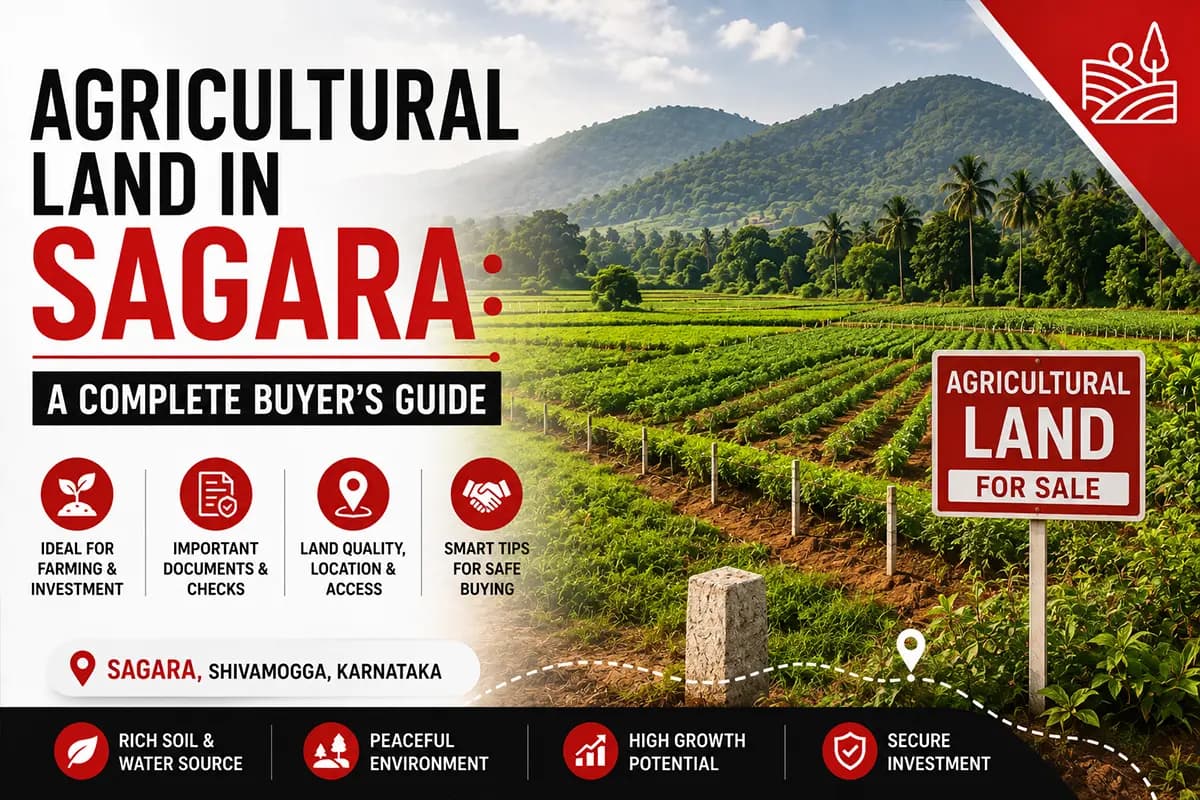
Buying agricultural land in Sagara can be very different from buying a house, residential plot or other urban property.
A farmland listing may look attractive because of its size, location or existing cultivation. But before you pay an advance, you need to establish what the land actually is, who owns it, whether the records are consistent, whether you can legally use it for your intended purpose and whether the physical property matches the documents.
Sagara is a taluk in Shivamogga district, Karnataka. The wider taluk includes both the town and rural areas administered through different local bodies, so buyers should verify the exact location and jurisdiction of every parcel rather than relying only on a listing description.
This guide focuses on the practical checks that matter when buying agricultural land in Sagara.
Quick Answer: What Should You Check Before Buying Agricultural Land in Sagara?
Before buying agricultural land in Sagara, check:
The exact survey number and land extent
The seller's ownership and title
RTC/Pahani and relevant land records
Mutation records where applicable
Encumbrance and registration records
Physical boundaries and survey details
Legal road access and right of way
Water availability and irrigation arrangements
Existing cultivation and structures
The land's current classification and permitted use
Any restrictions, claims, disputes or government notices
The applicable registration and land-use requirements
Most importantly, do not treat agricultural land as a residential plot simply because it is close to a road or town.
The intended use of the land needs to be checked against its legal classification and the applicable rules.
1. First Decide Why You Want to Buy Agricultural Land
Your reason for buying should influence the property you choose.
You may be looking for agricultural land because you want to:
Continue farming
Start or expand cultivation
Maintain an existing plantation
Own a larger rural property
Explore agricultural activities
Hold land for the long term
Use the land for another purpose that may require separate permissions
These are very different objectives.
For example, land that works well for active cultivation may not be suitable for someone primarily looking for a future residential property.
Before looking at listings, write down your intended use.
Then make sure the land you are considering can legally be used for that purpose.
2. Agricultural Land Is Not the Same as a Residential Plot
One of the most important distinctions for buyers is the difference between agricultural land and land that is already approved or converted for another use.
Agricultural land is subject to its own land-use framework.
If your actual intention is to build a house, farmhouse, commercial structure or other non-agricultural development, do not assume that you can simply buy agricultural land and begin construction.
Karnataka's land-revenue framework contains provisions dealing with diversion of agricultural land to other uses. Using agricultural land for another purpose can require the applicable permission or conversion process.
The correct process depends on the land, proposed use and applicable rules.
That is why "farmhouse potential" or "future residential use" in a property advertisement should never be treated as proof that construction is legally permitted.
3. Start With the Exact Survey Number
Before discussing price seriously, identify the exact parcel.
Ask the seller for:
Survey Number
Subdivision details, where applicable
Total land extent
Village name
Hobli or other relevant administrative details
Taluk
District
Available survey sketch or related records
The property should be identifiable consistently across the relevant records.
Do not rely only on a map pin or a verbal description such as "the land next to this road."
A rural property can have multiple adjoining parcels, and a small misunderstanding about the survey number or boundary can create a major problem later.
4. Check the RTC and Pahani
RTC stands for Record of Rights, Tenancy and Crops.
Pahani is a commonly used term for the RTC record in Karnataka.
For agricultural land, these records are important because they can provide information connected with the land and its recorded rights.
When reviewing the relevant record, compare details such as:
Owner's name
Survey number
Land extent
Land classification
Cultivation-related information where recorded
Other relevant entries
Do not look at the RTC in isolation.
The information should be compared with the sale deed, mutation records, survey information and other relevant documents.
Karnataka's Bhoomi system is the state's land-record system and provides services connected with land records and mutation.
5. Verify the Seller's Ownership
The person showing you the land is not necessarily the person legally entitled to sell it.
Ask for the relevant ownership documents and establish how the seller acquired the property.
Depending on the property's history, this may involve reviewing:
Current sale deed
Previous sale deeds
RTC/Pahani
Mutation records
Partition documents, where applicable
Inheritance-related documents, where applicable
Court or settlement documents, where applicable
Other title records
The exact document set depends on the property's history.
If the land has passed through inheritance, partition or multiple transfers, the title history deserves particular attention.
If the seller cannot clearly explain the ownership history, do not rush into an advance payment.
6. Check Mutation Records
Mutation refers to the recording of a change in relevant land records following a transaction or other qualifying change.
Mutation information can help you understand whether the land records have been updated following earlier transactions.
However, mutation should not be treated as a substitute for title verification.
A proper review should compare the mutation history with:
Sale deeds
RTC/Pahani
Ownership details
Survey information
Other relevant records
If the names or dates do not line up, ask why before proceeding.
7. Check the Encumbrance Certificate
An Encumbrance Certificate, commonly called an EC, is another useful part of property due diligence.
Use it to check the relevant registered transaction information for the property and compare it with the title history.
An EC is not a complete substitute for title verification.
For example, a buyer should not assume that obtaining an EC alone proves that there are no possible disputes or issues relating to the property.
The EC should be reviewed together with the other records and the property's history.
8. Check the Land Classification and Intended Use
This is especially important when buying agricultural land.
Before purchasing, establish:
What is the land classified as today?
Then ask:
What do I actually intend to do with it?
If the answers are different, investigate the applicable land-use rules before proceeding.
For example, do not assume that you can:
Build a residence
Construct a commercial building
Divide the land into residential sites
Establish a non-agricultural business
Use the property for another non-agricultural purpose
simply because you own the land.
Karnataka's land-revenue law contains provisions relating to diversion of agricultural land for other purposes, including the consequences of using agricultural land for another purpose without the applicable permission.
Because land-use rules can change, buyers should verify the current position for the specific property and proposed use.
9. Inspect the Land in Person
Never buy agricultural land based only on photographs or a listing description.
Visit the property.
Walk the entire parcel if possible and inspect:
Physical boundaries
Fencing
Existing crops
Trees
Slopes
Low-lying areas
Drainage
Water sources
Existing structures
Internal roads
Access points
Neighbouring properties
A parcel can look very different on a map compared with what you find on the ground.
If the land is large, consider getting a qualified survey professional to help establish the boundaries.
10. Check the Boundaries Carefully
Boundary problems can become serious after a purchase.
During the site visit, compare the physical boundaries with the available records.
Look for:
Fencing
Boundary stones
Natural boundaries
Existing roads
Streams or water channels
Neighbouring cultivation
Encroachments
Structures crossing apparent boundaries
If the physical extent appears different from the documents, stop and investigate.
Do not assume that a difference of a few feet is insignificant.
On a larger parcel, even a relatively small boundary discrepancy can affect the actual land area involved.
11. Check Road Access and Right of Way
Road access is one of the most important practical checks for agricultural land.
Ask:
How do you reach the property?
Is the road physically usable?
Is it shown or recognised in the relevant records?
Does the access cross someone else's land?
Is there a documented right of way where necessary?
Can vehicles reach the property?
Can agricultural equipment reach the land?
A parcel may appear close to a public road but still have difficult or disputed access.
Do not rely on statements such as:
"Everyone uses this road."
Establish the legal and practical basis for access before buying.
12. Check Water Availability
Water can be one of the most important practical considerations for agricultural land.
Ask about:
Open wells
Borewells
Streams
Irrigation sources
Water storage
Existing irrigation systems
Seasonal availability
Water-sharing arrangements, where applicable
Do not assume that a property with a well or borewell will always have sufficient water.
Ask how the existing cultivation is supported and inspect the system yourself.
If water availability is central to your intended use, consider getting appropriate technical advice rather than relying solely on the seller's statement.
13. Understand What Is Already Growing on the Land
If the property is being sold as cultivated land or plantation land, identify what is actually present.
Ask:
What crops are currently grown?
How old are the plantations, if any?
Who currently manages the land?
What irrigation is used?
Are there existing farm structures?
Are there agricultural agreements or arrangements with other parties?
What maintenance is required?
Do not assume that the presence of mature crops automatically means the land is profitable.
Agricultural performance depends on many factors, including management, water, soil, weather, labour and market conditions.
Avoid buying based on promised future returns.
14. Check for Existing Tenancy or Cultivation Arrangements
Ask whether anyone other than the seller is currently:
Cultivating the land
Leasing the land
Managing the plantation
Using structures on the land
Claiming rights over the property
If someone else is cultivating the land, understand the legal and contractual position before purchasing.
Do not assume that a person working on the land will automatically leave after the sale.
Any existing arrangement should be investigated properly.
15. Look for Restrictions, Claims and Disputes
Ask whether the property is affected by:
Court cases
Family disputes
Government notices
Acquisition proposals
Boundary disputes
Encroachments
Easement or access disputes
Restrictions recorded in relevant documents
Other claims over the land
Do not rely only on the seller's answer.
Where the transaction is significant, independent legal due diligence is worth considering.
16. Be Careful With Land Near Roads, Water Bodies and Forest Areas
Location can create additional questions for agricultural land.
If a parcel is close to:
A major road
A water body
A stream
Forest land
Government land
A protected or restricted area
Another sensitive boundary
ask whether any additional restrictions or permissions apply.
Do not assume that proximity to an attractive natural feature automatically increases the land's usable value.
The actual legal status and applicable restrictions need to be established for the individual parcel.
17. Do Not Assume Agricultural Land Can Be Converted Easily
This is a common mistake.
A buyer may see a large agricultural parcel and think:
"I can buy this now and convert it later."
That assumption can be risky.
Conversion or diversion is a separate issue from ownership.
Before buying with future development in mind, investigate:
Whether conversion is legally possible
Which authority handles the process
What documents are required
Whether there are land-use restrictions
Whether planning or zoning requirements apply
What costs and conditions may apply
Karnataka's land-revenue framework contains specific provisions governing diversion of agricultural land for other purposes.
The rules should be checked at the time of purchase rather than based on an old article, broker statement or previous transaction.
18. Understand the Current Rules on Agricultural Land Purchases
This is an area where older online information can be misleading.
Karnataka's agricultural land laws have been amended over time. The Karnataka Land Reforms and Certain Other Law (Amendment) Act, 2025 introduced further amendments, including changes relating to Section 109.
That means buyers should be careful with statements such as:
"Only farmers can buy agricultural land."
"Anyone can buy agricultural land without restrictions."
"This land can automatically be converted."
"The old restrictions no longer apply."
The correct answer depends on the current law and the particular property.
Before completing a purchase, verify the current legal position and obtain professional advice where necessary.
19. Check the Survey and Measurement
Agricultural land is often discussed in acres, guntas and other measurements.
Do not rely only on the seller's stated area.
Compare:
Sale deed area
RTC area
Survey records
Survey sketch
Physical measurement
If the transaction involves a substantial parcel or there is uncertainty about the boundaries, consider an independent survey.
A difference between the advertised area and the legally documented area should be resolved before negotiation is finalised.
20. Check Existing Structures
Some agricultural properties have:
Farm buildings
Sheds
Storage structures
Wells
Pump houses
Fencing
Other improvements
Do not assume that every structure on agricultural land is automatically authorised.
Ask what the structure is, who built it, when it was built and whether relevant permissions or records apply.
If your plan depends on an existing structure, verify its legal status before assigning value to it.
21. Think About the Total Cost, Not Just the Price of the Land
The purchase price is only one part of the cost.
Depending on the property and your plans, you may also need to consider:
Stamp duty
Registration charges
Legal due diligence
Survey costs
Fencing
Road improvements
Water infrastructure
Irrigation
Land maintenance
Agricultural equipment
Plantation maintenance
Repairs to existing structures
Do not use a generic percentage to estimate the government's charges.
Verify the applicable current charges before completing the transaction.
22. What Documents Should You Ask For?
The exact document set depends on the land and its history, but a buyer may need to review:
Sale deed
Previous title documents
RTC/Pahani
Mutation records
Encumbrance Certificate
Survey records
Survey sketch where applicable
Identity documents
Partition or inheritance documents where applicable
Tax or revenue records where relevant
Documents relating to existing structures
Conversion/diversion records if applicable
The goal is not to collect as many documents as possible.
The goal is to establish a consistent story about:
Who owns the land → what land is being sold → what rights exist → what use is permitted → whether any claims or restrictions exist.
23. Ask the Seller These Questions
Before making an offer, ask:
Why are you selling the land?
How did you acquire it?
How long have you owned it?
Are you the sole owner?
Are there co-owners or legal heirs?
Is anyone cultivating the land?
Is the land leased?
Is there any existing loan or claim?
Is there a dispute with a neighbour?
How is the property accessed?
What is the water source?
Are there any government notices?
Are there any existing structures?
Has any part of the land been converted?
Are all original documents available?
Then verify the answers independently.
24. Do Not Pay an Advance Too Early
An agricultural land transaction can involve more due diligence than a simple residential purchase.
Before paying a significant advance, establish the basic facts about:
Ownership
Survey identity
Land extent
Access
Classification
Existing claims
Intended use
Major document discrepancies
If important questions remain unanswered, pause the transaction.
An attractive price should not be a reason to skip due diligence.
25. What About Buying Agricultural Land as an Investment?
Agricultural land should not automatically be described as a good investment.
Its suitability depends on factors such as:
Purchase price
Location
Land quality
Water
Access
Current use
Management requirements
Legal status
Holding period
Resale demand
Your intended purpose
There is no guarantee that agricultural land will appreciate in value.
If you are considering farmland primarily as an investment, evaluate it as a property with costs, risks and holding requirements rather than assuming future appreciation.
26. A Practical Agricultural Land Checklist for Sagara
Before the Site Visit
Seller identified
Survey Number obtained
Village and location confirmed
Approximate land extent confirmed
Basic asking terms understood
During the Site Visit
Boundaries inspected
Access road checked
Water source checked
Existing cultivation inspected
Existing structures inspected
Neighbouring properties checked
Signs of encroachment checked
Terrain and drainage observed
Document Verification
Sale deed reviewed
Previous title documents reviewed
RTC/Pahani checked
Mutation records checked where applicable
EC checked
Survey details compared
Land extent compared
Ownership names compared
Existing claims investigated
Land-use status checked
Before Agreement
Legal due diligence completed
Major discrepancies resolved
Access position understood
Intended use checked
Conversion/diversion requirements investigated where applicable
Total purchase cost calculated
Agreement terms understood
Before Registration
Final documents reviewed
Seller identity confirmed
Property description confirmed
Applicable government charges verified
Registration process confirmed
Payment terms documented
27. Common Mistakes to Avoid
Buying Based on the View
A beautiful parcel is not necessarily a legally straightforward parcel.
Assuming More Acres Means Better Value
Land quality, access, water, location and legal status matter alongside size.
Trusting the Listing Description
Verify the land classification, survey details, extent and ownership yourself.
Assuming Road Access Is Guaranteed
A visible track is not automatically the same as a legally established right of access.
Assuming a Borewell Means Reliable Water
Ask how the water source performs over time and what the current system actually supports.
Ignoring the Land's Intended Use
If your plan involves construction or another non-agricultural activity, investigate the applicable land-use requirements before purchasing.
Using Old Legal Information
Agricultural land rules can change. Verify the current position before completing a transaction.
Paying an Advance Before Due Diligence
Resolve major document and ownership questions first.
28. Agricultural Land in Sagara: A Safer Buying Process
A practical process is:
1. Decide your intended use
↓
2. Shortlist suitable land
↓
3. Obtain the survey and basic property details
↓
4. Visit the land personally
↓
5. Check access, water and boundaries
↓
6. Review ownership and land records
↓
7. Check EC, mutation and relevant history
↓
8. Verify land classification and permitted use
↓
9. Resolve discrepancies and obtain professional advice where needed
↓
10. Negotiate the purchase
↓
11. Complete the agreement and registration process
↓
12. Take possession after the transaction is completed
The most important step is the one buyers are sometimes tempted to skip:
Verify before you commit.
Frequently Asked Questions
Is agricultural land in Sagara suitable for farming?
That depends on the individual parcel.
Buyers should evaluate the land's existing use, water availability, access, physical condition and other site-specific factors rather than assuming that every agricultural parcel is equally suitable.
Can I build a house on agricultural land in Sagara?
Do not assume that you can.
Agricultural land and residential land have different land-use considerations. If your intention is to build a house or another non-agricultural structure, check the applicable conversion, diversion, planning and building requirements before purchasing.
What documents should I check before buying agricultural land in Sagara?
The relevant documents depend on the property, but buyers should generally investigate the title documents, RTC/Pahani, mutation records where applicable, EC, survey information, land extent, ownership and relevant land-use records.
What is RTC or Pahani?
RTC stands for Record of Rights, Tenancy and Crops. Pahani is a commonly used term for the RTC record in Karnataka.
Is an EC enough to prove that agricultural land is safe to buy?
No.
An EC is one part of due diligence. It should be reviewed together with title documents, land records, survey information and other relevant records.
How do I verify the boundaries of agricultural land?
Compare the physical boundaries with the survey and land records.
If there is uncertainty, an independent survey by a qualified professional can help establish the actual boundaries.
How important is road access?
Very important.
A parcel that is difficult to access can create practical problems for cultivation, maintenance, equipment movement and future resale.
Check both the physical access and the legal basis for access where necessary.
How important is water availability?
It can be critical for agricultural use.
Check the actual water sources, irrigation arrangements and seasonal reliability rather than relying only on the seller's description.
Can agricultural land be converted to residential use?
Conversion or diversion may be required when agricultural land is proposed to be used for a non-agricultural purpose.
The applicable process depends on the property, proposed use and current Karnataka rules.
Verify the position for the specific parcel before purchasing with construction plans in mind.
Can anyone buy agricultural land in Karnataka?
Do not rely on simplified statements found in older property articles.
Karnataka's land laws have changed over time, including amendments in 2025. The current eligibility and restrictions should be verified against the applicable law and the specific property before purchase.
Should I hire a lawyer before buying agricultural land?
For a significant purchase, independent legal due diligence can be valuable.
This is particularly important where there are inheritance issues, multiple owners, old title documents, boundary disputes, land-use questions or other complications.
Should I buy agricultural land only as an investment?
Not necessarily.
Agricultural land can involve ongoing management, access, water, cultivation and legal considerations. Buy based on your actual objectives and the individual property's characteristics rather than assuming future appreciation.
Final Thoughts
Buying agricultural land in Sagara requires a different mindset from buying a house or residential plot.
The most attractive property is not necessarily the safest one to buy.
Before committing your money, establish:
What land am I buying?
Who legally owns it?
Do the records match the land?
Can I access and use it for my intended purpose?
Are there any claims, restrictions or unresolved issues?
Once those questions have been answered, you can make a much more informed decision.
If you are looking for agricultural land in Sagara, use this checklist when comparing properties and complete the necessary document and legal checks before making an advance or finalising a purchase.